Can Books Make You Happy?
Can books make you happy? The short answer is yes. Books certainly contribute to my happiness — I love to read. Can books teach you how to be happy? There is no definitive answer, but it seems like people have been writing instruction manuals on how to be happy since the printing press was invented, and probably before that. Do self-help books actually help? It is hard to say, but many of them have had a major impact on the society in which they are written, and some beyond that. Gretchen Rubin wrote her first book on happiness in 2009. Since then, she has turned her happiness projects into her own industry, including six books, a weekly podcast, online classes, a virtual happiness swag store and her sister’s spin-off of the original podcast, "Happier in Hollywood." (Rubin’s sister, Elizabeth Kraft, is a writer in Hollywood.)
Gretchen Rubin was not the first author of a book on happiness, and she is not the last either. Her 2009 release, “The Happiness Project: Or Why I Spent a Year Trying to Sing in the Morning, Clean My Closets, Fight Right, Read Aristotle, and Generally Have More Fun,” ushered in a new wave of self-help philosophy that extended to tv, movies, podcasts and social discourse on the meaning of life.
Americans spent $563 million dollars on self-help books in 2000. (Paul, 2001). What are we buying? Rubin boasts a large array of disparate sources she tapped into to boost her own happiness, then wrote her books to inspire others to create their own happiness projects. Her method of reading the history of happiness efforts in order to inform her own left me both inspired and excited to explore the intersection of both history and happiness. While conventional wisdom dictates that self-help books are a mid-20th century phenomenon (Arbib & Kvity, 2004), the sources Rubin draws on go back millennia. I am fascinated by the gamut her inspiration runs, so I am taking a deep dive into some of her favorites.
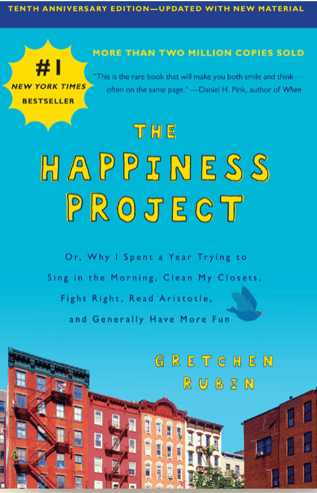
Figure 1.
Jacket design by Archie Ferguson and Christine Van Bree

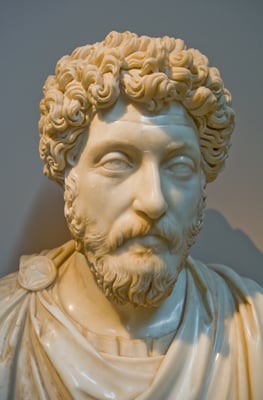
Figure 2. Marcus Aurelius
iStock photo.
In 2023, Swedish influencer Saskia Cort used her Instagram account to show how often many men thought about the Roman Empire. It seems men are not the only ones looking to the distant past for wisdom, nor is it the only era in which people are interested. The Ancient Greek Stoics have enjoyed a popular culture renaissance, although in truth they never really left. Many disparate figures in pop culture cite the Stoics, such as author Tom Wolfe, one of whose main characters discovered how to recover his life in jail by reading about the Stoics in “A Man in Full.” Jerry Seinfeld, JK Rowling and Anna Kendrick have all referenced the Stoics in their social media as a means to keep them grounded. Brie Larson has tweeted quotes from Marcus Aurelius’ Meditations. Aurelius is a favorite of Stoic podcaster Tanner Campbell, whose popular podcast is “Practical Stoicism.”
The Wall Street Journal heralded this phenomenon in 2017. While the word stoic means “(o)ne who is seemingly indifferent to or unaffected by joy, grief, pleasure, or pain(Merriam Webster, 2024),” the Stoics’ philosophy emphasizes thinking deeply about how to live, how to view things in such a way to emphasize the good and manage what we view as bad. Further, these exercises and philosophies have stayed relevant to many generations of people for more than 2000 years. (Stoicism counts its inception from 300 B.C.E.)
Learn to separate what is and isn't in your power.
Contemplate the broader picture.
Think in advance about challenges you may face during the day.
Be mindful of the here and now.
Before going to bed, write in a personal philosophical diary. This exercise will help you to learn from your experiences—and forgive yourself for your mistakes.
(Pigliucci, 2017)
The Stoics
The Five Takeaways WSJ Reporter Pigliucci emphasized in 2017 were:


Figure 3


Benjamin Franklin
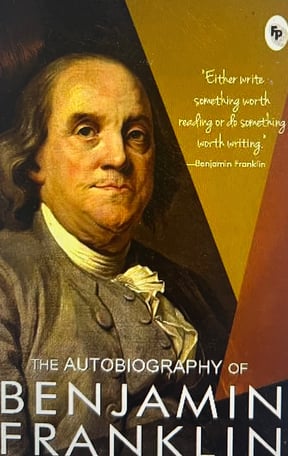
Rubin lists “The Autobiography of Benjamin Franklin” as one of three books that “most influenced my own happiness project.” (Rubin, 2009). This is not surprising, as Franklin’s prolificacy included voluminous thoughts and writings on self-improvement. In some ways, he is one of the Founding Fathers of self-improvement, albeit far after the Stoics. Like Rubin, Franklin found it helpful to make lists and create categories, and his 13 Virtues were foundational for Rubin’s project.

Here are Benjamin Franklin’s thirteen virtues as he described them in his Autobiography:
Temperance: Eat not to dullness. Drink not to elevation.
Silence: Speak not but what may benefit others or yourself. Avoid trifling conversation.
Order: Let all your things have their places. Let each part of your business have its time.
Resolution: Resolve to perform what you ought. Perform without fail what you resolve.
Frugality: Make no expense but to do good to others or yourself: i.e., Waste nothing.
Industry: Lose no time. Be always employed in something useful. Cut off all unnecessary actions.
Sincerity: Use no hurtful deceit. Think innocently and justly; and if you speak, speak accordingly.
Justice: Wrong none by doing injuries, or omitting the benefits that are your duty.
Moderation: Avoid extremes. Forbear resenting injuries so much as you think they deserve.
Cleanliness: Tolerate no uncleanness in body, clothes, or habitation.
Tranquility: Be not disturbed at trifles, or at accidents common or unavoidable.
Chastity: Rarely use venery but for health or offspring; never to dullness, weakness, or the injury of your own or another’s peace or reputation.
Humility: Imitate Jesus and Socrates.
Here are Benjamin Franklin’s thirteen virtues as he described them in his Autobiography:

Rubin’s twelve commandments are:
Be Gretchen.
Let it go.
Act the way I want to feel.
Do it now.
Be polite and fair.
Enjoy the process.
Spend out.
Identify the problem.
Lighten up.
Do what ought to be done.
No calculation.
There is only love.
Rubin, p. 81. 2009
Rubin is not the only modern person who still finds Franklin’s guidelines to living a good, which to him was synonymous with happy, life. As of August 2017, there were still meetings of groups of adult who met regularly and modeled themselves on “Franklin’s Junto, his Philadelphia ‘club for mutual improvement’ that met every Friday evening to discuss the virtues, the modern circles range from invitation-only dinner gatherings to public meetings in municipal libraries.” (Kadet, 2017).
Part of why Franklin was so inspirational to Rubin was their similarity. Despite the 250 year difference between them, their goals and methods are quite alike, from list-making to feeling the need to prepare themselves for what the future could hold. Is this because Rubin read Franklin’s writings so closely? Perhaps. But of her many resources for her happiness project, Franklin’s autobiography was one of only three books listed as most influential. Rubin writes, “I started my happiness project because I wanted to prepare. I was a fortunate person, but the wheel would turn…One of my goals for the happiness project was to prepare for adversity - to develop the self-discipline and the mental habits to deal with a bad thing when it happened.” (Rubin, p. 117, 2009). Frankling famously coined the much-used phrase, “By failing to prepare, you are preparing to fail.” (Franklin, 1777).


Figure 4.
Credit: RebelMod

Buddhism
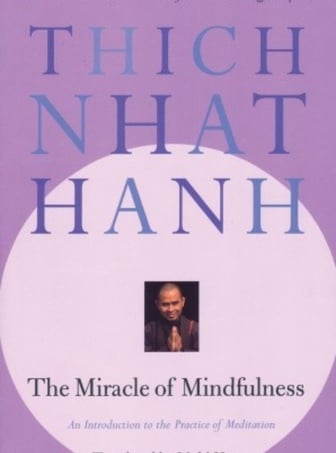
Thich Nhat Hanh’s “The Miracle of Mindfulness: An Introduction to the Practice of Meditation,” is one of several Buddhism-based books that Rubin refers to in her happiness projects, including her first one. I have tried to stay away from religion in this project, but it has proved to be impossible, as religion is such an ineffable part of many peoples’ lives, particularly those from eras in which one’s religion was one of if not the most defining characteristic of the self. Franklin held the figure of Jesus up as the highest standard to which he could compare himself. He always found himself wanting, naturally, as he valued humility and was too G-d fearing to ever compare himself favorably, but Jesus was the standard to which he aspired. Rubin herself torpedoed my efforts to avoid religiosity in her book “The Happiness Project:” “When I told people I was working on a book but happiness, the single most common response was, ‘You should spend some time studying Buddhism.’” (Rubin, 2009). While she did not whole-heartedly embrace the tenets of Buddhism, she does say that “studying Buddhism made me realize the significance of some concepts I overlooked. The most important was mindfulness — the cultivation of conscious, nonjudgmental awareness.” (Rubin, p. 235, 2009)
Even after studying mediation and mindfulness in Thich That Hanh’s book and the Dalai Lama’s “The Art of Happiness: a Handbook for Living,” she still admits to being a non-practicing meditator, although she did and does still try to embrace mindfulness. This “failure” makes Rubin’s project realistic and relatable. It also keeps her on-brand with her first commandment, “Be Gretchen.” While detachment and mediation did not resonate with her, she loved the “numbered lists that pop up through Buddhism: the Triple Refuge, the Noble Eightfold Path and the Four Noble Truths.” (Rubin, 2009).
Perhaps it was inevitable that Buddhism and Rubin find each other as she conducted her happiness project. One of the basic tenets of Buddhism is mindfulness, which necessitates living in the moment; not the future and not the past. Rubin notes, “As I became more aware of the preciousness of ordinary life, I was overwhelmed by the desire to capture the floods of moments that passed practically unnoticed” (Rubin, 2009). Rubin reached for a newspaper to while away the time waiting for the ferry to take her family home from a beach vacation, then looked at her then pre-school daughter, Eleanor, realizing, “ This was my precious, fleeting time with Eleanor as a little girl…why would I want to distract myself from the moment by reading the paper?” (Rubin, 2009). As Thích Nhất Hạnh writes in "The Miracle of Mindfulness," “Mindfulness… is the miracle which can call back in a flash our dispersed mind and restore it to wholeness so that we can live each minute of life” (Thích Nhất Hạnh, p. 58, 1975).

Other Peoples' Happiness Projects
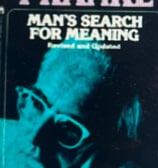
While Rubin organizes this book around the calendar year (each chapter is a different month, beginning expectedly with January), she sprinkles each month with topic-related examples of other people’s happiness projects. It is likely that the authors of these books did not intend to create their own happiness projects (although some did and named it such) but that was how Rubin saw them. Books she listed in this category are disparate in tone and content, including Viktor Frankel’s “Man’s Search for Meaning,” Elizabeth Gilbert’s “Eat, Pray, Love” and Maugham Somerset’s “The Summing Up.” Just as examples of previous class assignments are instructive for future students (including me), so Rubin looked to other fellow searchers for “maps” to finding their own elusive happiness and purpose for direction to divine her own.
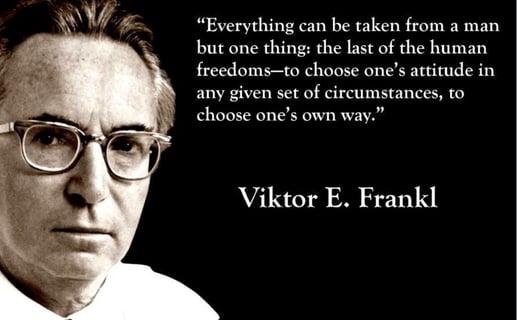
Figure 5
Copyright T. Muldoon
Rubin wanted to garner as much strength and fortitude as possible; not just because these are admirable qualities, but because although her life was relatively peaceful and happy, she knew life’s vicissitudes were likely to catch up with her eventually, as they do with (almost) everyone else. Therefore, she embarked on reading what she called “memoirs of catastrophe.” “I wanted to strengthen myself so I’d have to fortitude to face the worst, if (ie, when) I had to” (Rubin, 2009). To this end, she read Martha Beck’s memoir of gestating and raising a baby with Down syndrome, Stan Mack’s on cancer and Gene O’Kelly’s on brain tumors. This list included Viktor Frankl’s memoir of surviving Dachau and Theresienstadt. One of his major realizations in the camps was that while he could not control what happened to him and around him, he could control his response as well as his perception of himself. He describes his therapeutic method called logotherapy, “which emphasizes finding meaning in life through work, love, and suffering. The book highlights the importance of purpose in overcoming adversity and maintaining hope even in the darkest circumstances.” (Wikipedia, 2024).
Rubin drew many lessons from her catastrophe reading. She gained a new appreciation for her healthy body, intact family and friends, and especially “greatly heightened appreciation for ordinary existence” (Rubin, p 197, 2009). And while she had a short, aborted dalliance with gratitude journals, she did find value in the act of feeling gratitude. She also reflected on the fragility of our everyday lives, regardless of the physical and political climate. “Everyday life seems so permanent and unshakable — but, as I reminded by these writers, it can be destroyed by a single phone call” (Rubin, p. 197, 2009). In other words, you are never finished preparing for the next bad (or good) thing to happen in your life. It is important both to be present for what happens and to appreciate the ebb and flow of life. It sounds simplistic, but the way Frankl (and others) drive home this tenet in horrific and memorable situations makes the lesson more impactful and distinctive.
Imitate a Spiritual Master
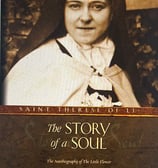
In August of Rubin’s happiness project, she decided to find and imitate a spiritual master. She used her blog to ask readers who they chose as their spiritual masters, if that had one, whether or not they called the person that or something else, or just someone they admired. She received many responses, listing a wide variety of spiritual masters, including Anne Lamott, Dr. Andrew Weil, Vincent Van Gogh, Dan Savage and Henry David Thoreau. She dutifully read books about or by these people (or both), but she did not find the inspiration she sought until she came to Saint Therese of Lisieux. Rubin first heard of Therese when she read Thomas Merton’s memoir, "The Seven Storey Mountain.” She was so surprised that the curmudgeonly Merton referred to Saint Therese as the “Little Flower,” that she was compelled to read books about her. Finally, Rubin’s husband asked how many books about Saint Therese Rubin planned to buy. Rubin realized she had bought 17 books about her, and had read every one, plus a videotape and a book that had nothing but photographs of Saint Therese in it. Rubin asked herself, “Why was I attracted to this Catholic saint, a French woman who had died at the age of twenty-four after having spent nine years cloistered with some twenty nuns?” (Rubin, p. 211, 2009).
Rubin realized that the reason Saint Therese so captivated her was because she achieved sainthood through “the perfection of small, ordinary acts.” (Rubin, p. 212, 2009). By caring for the poor and living her adult life simply in a convent, she was able to “show that ordinary life, too, is full of opportunities for worthy, if unconspicuous, virtue.” (Rubin, p. 212. 2009). Saint Therese once wrote that because she loved G-d and her nun sisters, she tried to appear happy and to actually be happy. When she lay dying of tuberculosis, her sisters observed that she would die laughing, as she always appeared to be so happy. In actuality, Saint Therese was suffering in body and spirit at the time, yet she brought light and laughter to those around her. Rubin is not a Catholic, nor am I, but I also found Saint Therese to be a figure of inspiration for personal happiness and elevating others, even if just in the act of making people smile through whatever they are going through in the moment. I may not buy seventeen books about her, like Rubin, but I will seek out her memoir, "The Story of a Soul."


Figure 6.
Cover for “Story of a Soul” photo: Office Central de Lisieux
...Not All Spiritual Masters are the same
While ostensibly a book about developing positive, healthy habits to replace self-destructive, unhealthy ones, Shapiro’s “Lighting Up,” has an irreverent tone that is similar but edgier to Rubin’s. While Rubin addresses family and marital happiness, she does not discuss sex nor other deeply personal aspects in any detailed, granular way. Shapiro, on the other hand, opens her book with an anecdote about visiting a therapist with her ex-boyfriend. “In the past, I had only bared my soul to female shrinks. The male head doctors I’d met were old Jewish guys in gray tweeds who smoked pipes. I could never talk about oral sex with anybody who resembled my grandfather.” (Shapiro, 2005) This reference to men who resemble her grandfather is heavy foreshadowing, as Shapiro realizes (with the indispensable help of her eccentric therapist) that addiction runs deep through her family (grandfather included) as it did in the “family” of many psychotherapists in history, including Sigmund Freud. By making us laugh and nod along, often through tears, Shapiro is able to both normalize the human condition as well as amplify its ups and downs. In addition, this book was an upbeat break from cancer, concentration camps and other calamity memoirs.


Figure 7
Credit: Mariya Paulina
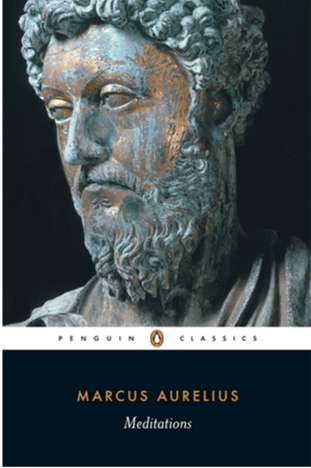
Book Gallery
Explore six captivating books that inspire happiness and knowledge.






References
Arbib, S. & Kvity, T. (2004) The publication of “Self-Help” books in Israel. Public Library Quarterly, Vol. 23(2) 2004. https://content.ebscohost.com/cds/retrieve?content=AQICAHiylJ_bvOB56hI8UzTN6Ryruh7a0kiIBN_ANwtaWYjmxwFkz6ec_deRpratnMGl4rhpAAAA2DCB1QYJKoZIhvcNAQcGoIHHMIHEAgEAMIG-BgkqhkiG9w0BBwEwHgYJYIZIAWUDBAEuMBEEDFygnHtFBqxZfKjQCwIBEICBkNgWiSwoDOfAZG8gHseO5PvWE9-CezmxQEDdDmP5Yaw1UsaiR_g1Sp7v7Z-WeMcPAuxeRpWq71RUcHnNc2gBl-kFzsln91EG6MytNbjqG2FEFFaaKjJw47LLWQmYNQTvuwFZ3JYPp910Ni9hFCv_ZFYtyMPogdQVDtCG7zXBP_UISPCMH1jn1DxooHpFEBZaSA==Write your text here...
Bergsma, A. (2008). Do self-help books help? Journal of Happiness Studies, 9(3), 341–360. https://doi-org.proxy.ulib.uits.iu.edu/10.1007/s10902-006-9041-2
Cambell, T. (host) (2022-present). Practical Stoicism. [Audio podcast]. Evergreen podcast. https://www.stoicismpod.com/
Frankl, V. (1946) Man’s search for meaning. Beacon Press.
Kadet, A. (2017) What Would Ben Franklin Say? Wall Street Journal. https://www.wsj.com/articles/what-would-ben-franklin-say-1503338450?mod=article_inline
Lieberman, E. (2015) Book review. Library Journal. https://web-p- ebscohost-com.proxy.ulib.uits.iu.edu/ehost/pdfviewer/pdfviewer?vid=2&sid=89923638-41e6-46a1-840f-5a1eac42fc83@redis
Merriam-Webster dictionary. https://www.merriam-webster.com/
N.D. (2011) If you’re happy and you know it, read a book. Publishers Weekly. 10/24/2011, Vol. 258 Issue 43, p26-26. 1/3p. https://web-p-ebscohost-com.proxy.ulib.uits.iu.edu/ehost/pdfviewer/pdfviewer?vid=4&sid=9ed1b040-7090-449c-9059-beed60931bcc@redis
Paul, A.M. (2001) Self-help books: shattering the myths. Psychology Today. March. https://web-p-ebscohost-com.proxy.ulib.uits.iu.edu/ehost/pdfviewer/pdfviewer?vid=3&sid=a9b3ef5a-fb35-43e6-ac25-2d539ca40556@redis
Pigliucci, M. (2017) Rules for modern living from the ancient stoics. Wall Street Journal. May 25, 2017. https://www.wsj.com/articles/rules-for-modern-living-from-the-ancient-stoics-1495723404
Publishers Weekly. 4/5/2010, Vol. 257 Issue 14, p27-31. 5p. https://web-p-ebscohost-com.proxy.ulib.uits.iu.edu/ehost/pdfviewer/pdfviewer?vid=7&sid=c96f3c5b-b973-4f5b-8b52-381157c29308@redis
Pytell, T. (2015) Viktor Frankl’s search for meaning: an emblematic 20th century life. Berhan Books.
Shapiro, S. (2005). Lighting up: how I stopped smoking, drinking, and everything else I loved in life except sex. Delacorte Press.
Therese, Saint of Lisieux. (1898). The story of a soul: the autobiography of St. Therese of Lisieux. Tan Classics.
Thích Nhất Hạnh. (1975). The Miracle of Mindfulness. Boston: Beacon Press.
Wikipedia. (2024) Viktor Frankl. https://en.wikipedia.org/wiki/Viktor_Frankl
Images:
Figure 1. “Happiness project.” Gretchen Rubin. Jacket designed by Archie Ferguson and Christine Van Bree. HarperCollins.
Figure 2. Marcus Aurelius. [image] iStock photo. ID: 2161528258
Figure 3. Benjamin Franklin [image] iStock. Credit:GwengoatStock illustration ID:1877239674Upload date: December 23, 2023. Location:United States
Figure 4. Founding Fathers Vintage Altered art Poster. [image] etsy. credit: RealMod. https://www.etsy.com/listing/1473611754/benjamin-franklin-vintage-altered-art?ga_order=most_relevant&ga_search_type=all&ga_view_type=gallery&ga_search_query=founding+fathers+ben+franklin+blowing+bubbles&ref=sr_gallery-1-1&content_source=c8c54a21b81ffac7c327565fccf39260899244df%253A1473611754&organic_search_click=1
Figure 5. Victor Frankl. (1946) [image] reprinting credit: Tim Muldoon. Medium.com. https://muldoont.medium.com/facing-our-hardships-with-hope-lessons-from-viktor-frankl-7a44b7bb4990
Figure 6. Saint Therese of Lisieux (1897). [image] Office Central de Lisieux. The copyright for the book is held by the Washington Province of Discalced Carmelites, Inc. Published by Tan Classics
Figure 7. cartoon woman [image] iStock photo. Stock file ID: 1412430053